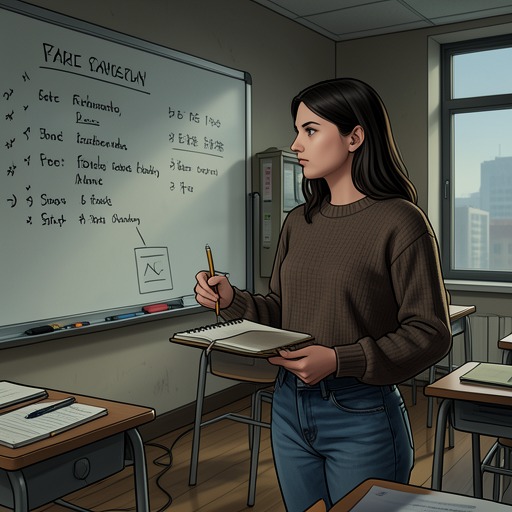
Auden refuses her mother's choice of the Pembleton program
Along for the RideAuden’s refusal of her mother’s choice of the Pembleton Program turns a practical college-housing decision into a dispute over who gets to define the life Auden wants. Her mother sees a quiet, academically focused dorm as protection from distraction; Auden objects to having that future selected for her, insisting that wanting more than study does not mean she has abandoned her academic priorities. The exchange ends without reconciliation, but with her mother conceding that the decision is Auden’s.
The orientation packet
The disagreement begins with an arrival from Defriese University. While sharing wine with Auden, her mother remembers a packet and asks whether Auden wants her to open it. Auden agrees. The papers include meal-plan information, updated transcript requests, and a roommate questionnaire due at the end of the week. What first appears to be ordinary preparation for college quickly becomes a decision about the kind of life Auden will be allowed to have there.
The questionnaire offers a way to request “alternate living arrangements.” As her mother reads, she explains that certain dorms or floors group students around a particular focus, such as foreign languages or sports. She finds the Pembleton Program and calls it perfect, then signs Auden up before asking what Auden thinks. The sequence matters: the mother’s confidence in the choice arrives before Auden has been consulted, so the disagreement is not only about the program’s merits but also about who has authority to make the choice.
What Pembleton promises
The program’s description presents its separation from ordinary campus life as a benefit. It is housed in a dorm removed from the main campus and offers academically strong students single rooms, on-site research materials, and close access to both libraries. Its stated purpose is to let students concentrate on their work without the distractions of regular dorm life. Auden’s mother reduces that arrangement to its practical appeal: “No roommate, no parties, no nonsense.”
Her interpretation draws on the kind of college experience she wants Auden to avoid. She warns that a conventional dorm could mean living with someone carefree and activity-loving, and later invokes drunk frat boys and gossiping girls. For her, Pembleton is not merely a convenient room assignment; it is an environment designed to shield Auden’s studies from social demands. Yet the very features that reassure her—solitude, distance from the main campus, and freedom from parties—make the choice feel restrictive to Auden. She says she does not want to spend every second studying, while taking care to clarify that school still matters to her.
Auden says no
Auden’s objection comes when her mother is about to sign her name. “Don’t,” she says, quickly interrupting an action already underway. She then qualifies her refusal, saying she is not sure she wants to live there. Her hesitation does not erase the central point: the decision has been made for her without her agreement. Her mother responds by emphasizing the distractions of dorm life and asking whether Auden wants to be stuck with a socially focused roommate. Auden concedes that she does not, but rejects the assumption that avoiding that possibility requires choosing a life devoted entirely to studying.
The disagreement sharpens when her mother frames Auden’s position as a sudden change in priorities, asking whether school has become unimportant in favor of boys, girlfriends, and clothes. Auden denies that interpretation. The contrast is between her mother’s either-or account—academic focus on one side, social life on the other—and Auden’s attempt to claim room for both. She does not reject education; she rejects the conclusion that wanting ordinary social experiences must mean that education no longer matters.
A decision left to Auden
The exchange touches a larger sensitivity for Auden. In the silence, she recalls her father attributing what she had done to the name he chose for her, taking credit for the good and leaving the bad to her. She bites her lip and tells her mother, “I haven’t changed. This is just me.” Her mother’s suggestion that this is part of Auden’s “blossoming” therefore lands in a conversation already charged with the question of whether other people can explain Auden to herself. Auden does not present her preference as a new identity or a rejection of her past; she insists that it belongs to who she is.
Her mother eventually draws a breath, becomes stiff and formal, and says she will put the packet in the mail: “You make your own decision.” The concession leaves the practical matter unresolved, but returns the choice to Auden. It does not restore their earlier ease. After Auden answers, neither speaks for a moment; her mother hangs up with a click, leaving Auden unsure how they could come back from the impasse. The ending gives the refusal a mixed consequence: Auden has prevented her mother from completing the enrollment, but asserting that independence exposes the distance between them rather than immediately closing it.